Your stomach tightens before a big meeting. Your energy crashes at 3 p.m. no matter how much coffee you pour into it. Your mood shifts for reasons you can’t quite name. You feel all of this in your body long before you understand where it comes from.
It comes from a place most people never think about: the dense, buzzing colony living inside your digestive tract right now. About 30 trillion microbial cells live on you and inside you, partnering with your own human cells to keep you alive. In fact, genetically speaking, you are less than 1% human; the collective genes of the microbes in your gut outnumber your human genes by a factor of 150 to 1.
Scientists call this population your gut microbiome. Your gut biome is a sprawling community of bacteria, viruses, fungi, and archaea that shapes far more than how well you digest your lunch. It is so impactful that researchers can look at the diversity of your gut bacteria alone and estimate your chronological age within 4 years (1).
Improving your gut health is not a passing wellness trend; it is how you build long-term resilience into your entire body and protect your longevity for decades to come.
The path to a healthy gut can be complex, but it does not need to be a guessing game. If you are ready to stop managing symptoms and start systematically repairing your gut lining, I have outlined the exact steps in my 7 Core Strategies to Heal the Gut Lining and Manage Leaky Gut.
My most popular resource bridges the gap between this article and the personalized protocol you need (and to identify why your current protocol may not be working).
Prebiotics vs. Probiotics: The Foundation
What is a prebiotic vs probiotic?
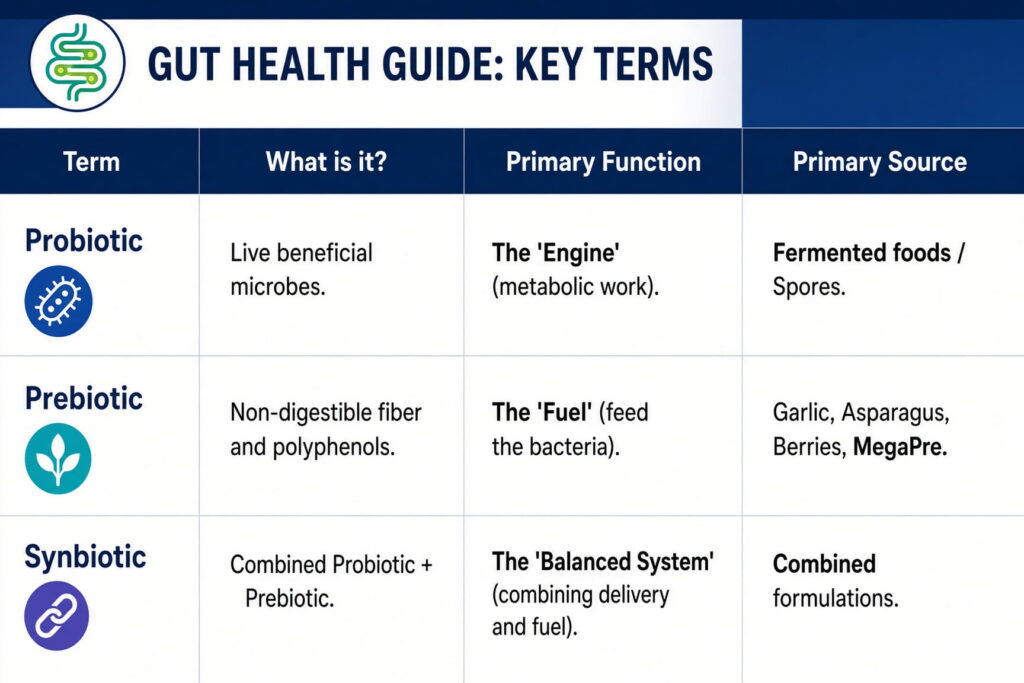
You will run into two similar-sounding terms almost immediately in the gut health world: prebiotics and probiotics. Rather than viewing them as two separate supplements you need to buy, you must understand them as two halves of one relationship.
Picture your probiotic bacteria as fermentation engines, and your prebiotic fiber as the fuel those engines burn. Probiotics are the live, beneficial microbes themselves that perform the metabolic work in your digestive tract. Prebiotics are non-digestible fibers, starches, and saccharides that travel intact through your stomach and small intestine until they reach your colon, where your bacteria eagerly ferment and consume them.
For precision prebiotic support that selectively feeds these beneficial strains without the gas associated with traditional fibers, I often recommend MegaPre. Taking a food-first approach delivers both halves of this relationship better than any pill. Asparagus, raw garlic, onions, Jerusalem artichokes, and chicory root supply the exact complex fibers your gut bacteria crave.
Science is also revealing that plant polyphenols act as “precision prebiotics,” feeding your beneficial microbes directly while starving out the bad ones (2).
Fermented foods deliver more enzymes and organic acids straight into your system: kimchi, traditional sauerkraut, kefir, and miso all carry live cultures ready to move in and start working.
Another term to be familiar with is synbiotics. This is a combination of a probiotic and a prebiotic.
A probiotic without prebiotic fiber in their diet or supplements to feed and maintain it is an expensive mistake millions of people make — so take a smart, synbiotic approach to your gut healing.
How Probiotics Function
Instead of viewing probiotics merely as digestive aids, you must understand them as highly active metabolic engines that run critical functions throughout your entire body. When these live microorganisms colonize your digestive tract, they do not just sit passively; they act as a sophisticated internal pharmacy, a border patrol, and an immune command center all at once.
Here are some of the most important functions your probiotics do for your body on a daily basis.
Competitive Exclusion
First, probiotics operate through a mechanism known as competitive exclusion. Your gut has limited real estate and finite resources. Beneficial probiotics actively compete with pathogenic bacteria and fungi for this physical space and nutrients, effectively starving out the harmful invaders.
In my clinical practice, I use MegaSporeBiotic to drive competitive exclusion, as its spore-based strains are exceptionally effective at crowding out opportunistic pathogens. They do not just outcompete pathogens; they actively attack them. Many probiotic strains manufacture potent antimicrobial compounds, known as bacteriocins, which act like targeted, naturally occurring antibiotics to suppress opportunistic “weeds” and pathogens in your system (3).
Through quorum sensing, spore probiotics constantly measure their own populations and read their environment, allowing them to release these targeted compounds exactly when and where the body requires them for homeostasis. They even release prebiotic and antioxidant compounds that promote growth of healthy bacteria when needed.
Gut Mucosal Lining
Second, probiotics are the primary architects and defenders of your gut’s mucosal barrier. The intestinal wall is only a single cell thick, yet it serves as the critical checkpoint keeping toxins and undigested food out of your bloodstream.
Probiotic bacteria reinforce this wall by enhancing the production of tight junction proteins, which physically seal the gaps between your intestinal cells, preventing intestinal hyperpermeability or “leaky gut” (4).
Vitamin Creation
Third, these microbes function as essential vitamin-synthesis factories. You rely on your gut bacteria to synthesize critical micronutrients that you cannot efficiently produce on your own, including Vitamin K, biotin, folate, and several essential B vitamins (5).
Certain specific probiotic strains also manufacture digestive enzymes on your behalf. For instance, specific Lactobacillus species have the genomic ability to produce beta-galactosidase, the exact enzyme required to break down lactose, thereby directly alleviating lactose intolerance and carbohydrate malabsorption (6).
Gut-Brain Connection
Fourth, probiotics exert profound systemic effects that extend far beyond digestion, most notably through the gut-brain axis. In this communication highway, the vagus nerve acts as a massive tether connecting your intestines to your brain.
When clients come to my practice struggling with afternoon brain fog, baseline anxiety, or stress-induced digestive flare-ups, they are often surprised when we start by addressing their gut ecosystem rather than jumping straight to mood, energy, or focus supplements.
Amazingly, the traffic moving up from your gut to your brain outweighs the downward traffic by a factor of eight, meaning the neurochemicals produced by your probiotics are actively dictating your baseline mental state. The bacteria in your gut produce up to 90% of your body’s serotonin and also strongly influence the production of dopamine and GABA, the neurotransmitters responsible for calm and focus (7).
Certain “psychobiotic” strains, such as Bifidobacterium longum 1714, have even been shown in clinical studies to alter brainwave activity, lower cortisol levels, and buffer the psychological response to stress, demonstrating that mental clarity is intrinsically tied to microbial health (8). This strain is found in Zenbiome Cope and Zenbiome Sleep, manufactured by Microbiome Labs.
Immune and Metabolic Regulation
Finally, modern science reveals that probiotics are central regulators of systemic immune and metabolic functions. Probiotics directly interact with the Gut-Associated Lymphoid Tissue (GALT), helping to promote T-regulatory cells that calm systemic inflammation and prevent autoimmune flare-ups (9; 10). These are the “referees” that not only keep your system balanced by warding off inflammation and potential infection, but also keep you from attacking yourself, as is the case with autoimmunity.
Cardiovascular Benefits
They also play a surprising role in cardiovascular health; recent human studies demonstrate that certain Lactobacilli and Bifidobacteria strains produce bile salt hydrolases (BSH), which break down conjugated bile salts in the intestine, thereby decreasing cholesterol reabsorption and actively lowering circulating blood cholesterol levels (11).
The Oral Microbiome Link
In your mouth, oral bacteria convert dietary nitrates into nitrite that is absorbed in your bloodstream and converted to nitric oxide. Nitric oxide then relaxes your blood vessels, supporting brain health, exercise performance, sexual performance, and more. Using an antiseptic mouthwash can raise your blood pressure and affect all of these areas — and you become more dependent on this oral microbiome pathway as you age (12).
Through these diverse mechanisms, probiotics contribute significantly to your overall physical and mental resilience.
The Survivability Crisis: Why Many Probiotics Fail to Colonize
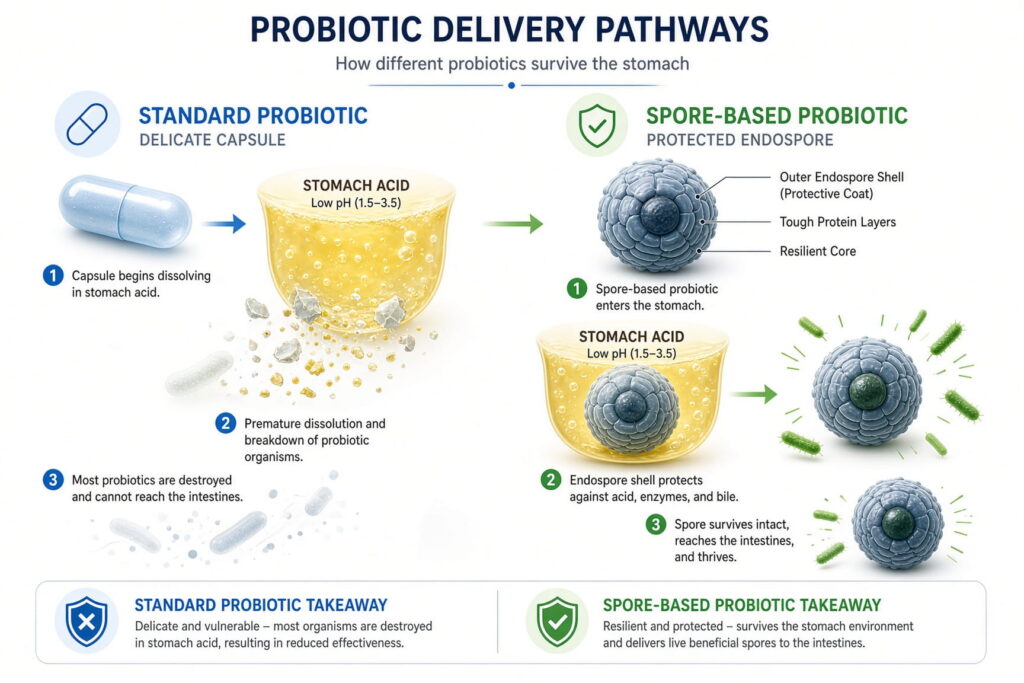
When we look at what traditional probiotic supplements actually do, a harsh reality emerges. Your stomach runs one of the most hostile chemical environments in your entire body. It is an acid bath strong enough to break down metal over time. Many probiotics are no different.
In my clinical experience, one of the most common mistakes I see is patients spending hundreds of dollars on high-CFU, refrigerated probiotics that get completely wiped out by stomach acid before ever reaching the colon. When we switch them to resilient spore-forming strains, the difference in clinical response is often night and day.
Standard, delicate strains like Lactobacillus and Bifidobacteria evolved for far gentler conditions. When these bacteria die before they ever reach your intestines, you swallow a capsule and absorb little of the benefit for which you thought you paid. The good news is that some professional companies have now introduced delayed-release or acid-protected capsules that safely deliver live organisms to the small and large intestines, where they attach and thrive.
For a broad-spectrum probiotic, I like TheralacPRO because it comes in a dark glass bottle, has acid-protected delivery, and is guaranteed to remain potent through expiration (not just at manufacture). In addition, many retail companies will throw 50+ strains into a formula, unknowingly introducing strains that compete with one another, effectively canceling each other out. Other strains may also be “filler” and have no verified activity in the human body. The strains in TheralacPRO were also selected to avoid these common problems.
While acid-protected delivery makes traditional broad-spectrum formulas like TheralacPRO
viable, another major breakthrough in microbiome science has been the resurgence of “spore-forming” probiotics, such as Bacillus subtilis and Bacillus coagulans (13). These soil-based organisms solve the survivability problem differently by naturally forming a tough endospore shell that shrugs off stomach acid, much like a seed coating shrugs off a hard winter. This is where I commonly use MegaSporeBiotic as a starting point in most gut protocols.
For more complex cases that may need an even more potent microbial “cleanse,” I often recommend adding additional Bacillus subtilis HU58 for its superior ability to crowd out unwanted bacteria.
Meet Your Keystone Strains & Postbiotics
Your native “keystone” strains hold your entire ecosystem in balance.
Akkermansia muciniphila, for instance, runs the demolition-and-rebuild crew for your gut lining by consuming old mucus and signaling intestinal cells to manufacture a fresh layer (13). Few single markers predict metabolic health and gut barrier integrity as reliably as Akkermansia (14).
For a deeper dive into the clinical research on Akkermansia, check out my full guide: Akkermansia muciniphila – Benefits, Supplements, and Gut Health. If you are ready to introduce this keystone strain into your daily routine, Pendulum Akkermansia is the leading commercial formulation.
Meanwhile, Bifidobacteria dominate your colon and regulate your immune response (15), and Faecalibacterium prausnitzii operates as a major player in the fight against inflammation (16). I like TrubifidoPRO because it contains a protective capsule, verified, research-backed strains that do not cross-compete with one another, and its potency is guaranteed throughout its shelf life, not just at the time of manufacture.
These keystone strains thrive when fueled by specific prebiotics like MegaPre, which I use to preferentially promote Bifidobacteria, F. prausnitzii, and Akkermansia, and not unwanted or potentially overgrown microbes.
The ultimate goal of feeding these strains is the production of postbiotics (8). Your gut bacteria ferment prebiotic fiber, and the resulting waste products include Short-Chain Fatty Acids (SCFAs) such as butyrate, propionate, and acetate (17). Butyrate alone is the primary fuel source for the cells lining your entire colon (18).
These postbiotics flood your bloodstream, calm systemic inflammation, steady your blood sugar, sharpen immune function, and literally quiet your appetite.
Protecting the Gut Barrier: The Threat of Leaky Gut
Every microbe in your gut lives directly on top of a delicate mucosal wall that is only one cell thick (19).
Chronic stress, NSAID pain relievers, excessive alcohol consumption, and a lack of dietary fiber all physically damage that checkpoint (20).
A frequent sequencing mistake I see in practice is trying to ‘seal the gut’ with mucosal-repair nutrients while still consuming reactive foods or taking NSAIDs frequently. In my clinical protocols, we always put out the fire first before we start rebuilding the physical structure. Your gut cannot be “on fire” and rebuilding at the same time.
When your gut wall leaks, your bloodstream directly absorbs toxic bacterial fragments called Lipopolysaccharides (LPS). Those LPS fragments trigger a state researchers call metabolic endotoxemia: a chronic, low-grade inflammation running quietly through your entire system (14).
Rebuilding that wall requires removing trigger foods and providing your body with targeted nutrients such as L-Glutamine, Zinc Carnosine, and specialized immunoglobulins. To address this, I frequently use MegaMucosa, which provides essential amino acids and dairy-free immunoglobulins to help restructure the mucosa, and MegaIgG2000, which helps bind toxins and reduce the systemic burden of leaky gut.
How to Improve Your Gut Biome
The daily habits required to build a thriving gut are surprisingly straightforward:
- Radical Dietary Diversity: The absolute number of different plant species you eat each week predicts your microbiome diversity better than any other single factor (21). Aim for 30 different plants a week to build a resilient ecosystem through a diverse source of prebiotic starches and colorful polyphenols (2).
When I first challenge my clients to hit 30 different plant species a week, the initial reaction is often overwhelm. But in practice, I show them how quickly that number adds up once you realize that pumpkin seeds, fresh oregano, green tea, and mixed spice blends all count toward that weekly diversity total. - Time-Restricted Eating (Fasting): Implementing a 12- to 16-hour overnight fasting window allows the Migrating Motor Complex (MMC) to activate, forcefully moving residual food and bacteria down through your intestines to prevent overgrowth (22).
- Eliminate Ultra-Processed Foods: Ultra-processed foods physically break down the integrity of your gut lining (23). Artificial sweeteners actively reshape your gut bacteria, pushing your system toward glucose intolerance and fat storage (24).
- Manage Stress and Sleep: Chronic stress directly disrupts your gut biome (24). Every spike of cortisol shifts your bacterial balance, highlighting that deep breathing and protecting your sleep are direct physical interventions for your gastrointestinal tract (25).
| Goal | Targeted Strategy | Product Recommendation |
| Foundation/Diversity | Selectively feed keystone strains | MegaPre |
| Broad-Spectrum Support | Acid-Protected Delivery | TheralacPRO |
| Pathogen/Weed Control | Competitive exclusion & overcrowding | MegaSporeBiotic |
| Keystone Metabolic Support | Akkermansia Replenishment | Pendulum Akkermansia |
| Mucosal Repair | Structure & barrier integrity | MegaMucosa |
| Toxin Binding | Systemic burden reduction | MegaIgG2000 |
| Fungal/Yeast Balance | Fungal root disruption | MegaMycoBalance |
| Baseline Diagnostics | Map microbial fingerprint | BiomeFx |
Can Probiotics Make Candida Worse?
Candida albicans is a normal type of yeast that lives naturally in your gut in very small amounts (26). However, high-sugar diets and chronic stress can compromise your defenses, pushing your system into fungal overgrowth (27).
Starting a probiotic during a bad Candida flare can trigger a rough few days of brain fog and bloating due to a “die-off” phenomenon known clinically as a Herxheimer reaction, and colloquially as “Herxing”. As newly introduced beneficial bacteria crowd out the yeast, dying Candida cells rupture, releasing toxins.
This is a normal, usually mild response, but it can be severe in sensitive individuals. Severe cases may cause fever, a rapid heart rate, or panic-like symptoms. If this occurs, stop your protocol, seek appropriate health consultation, and after things calm down, introduce your protocol more slowly, often one product at a time. This response lasts just a few hours to as long as 5-7 days. A slow approach, along with liver- and immune-balancing support, can help.
For those who are sensitive, I often let my clients know that it’s often a “push the accelerator, then tap the brakes” type approach.
For these cases, I often add MegaMycoBalance, which uses undecylenic acid and bee propolis to disrupt the yeast’s “roots” (hyphae) and help manage fungal populations naturally. Specific beneficial probiotic yeasts, like RestorFlora (which contains Saccharomyces boulardii), also compete directly with pathogenic Candida for physical space and nutrients, helping flush it out of your system without feeding it sugar (28).
Test Your Gut Microbiome, Don’t Guess
It is very common for new clients to walk into my practice with a bag full of 10 or 15 different supplements they’ve pieced together online with minimal results. Running a targeted stool test like BiomeFx ends that expensive trial-and-error cycle by telling us precisely which keystone strains need support.
No two gut biomes run the exact same program, meaning your bacterial signature is as unique as your fingerprint. If your symptoms, such as stubborn bloating, brain fog, fatigue, or mood swings, are still talking to you after you’ve nailed the basics, do not try to out-supplement the problem blindly.
I recommend running the BiomeFx stool test to map your microbial fingerprint with precision. Once you know precisely which keystone strains you are missing, you can rebuild your gut with real, scientific precision.