
Yes, NAC and glycine work well together (1). The pairing makes sense mechanically, since each supplies a different piece of the same molecule.
Do you need to take glycine with NAC?
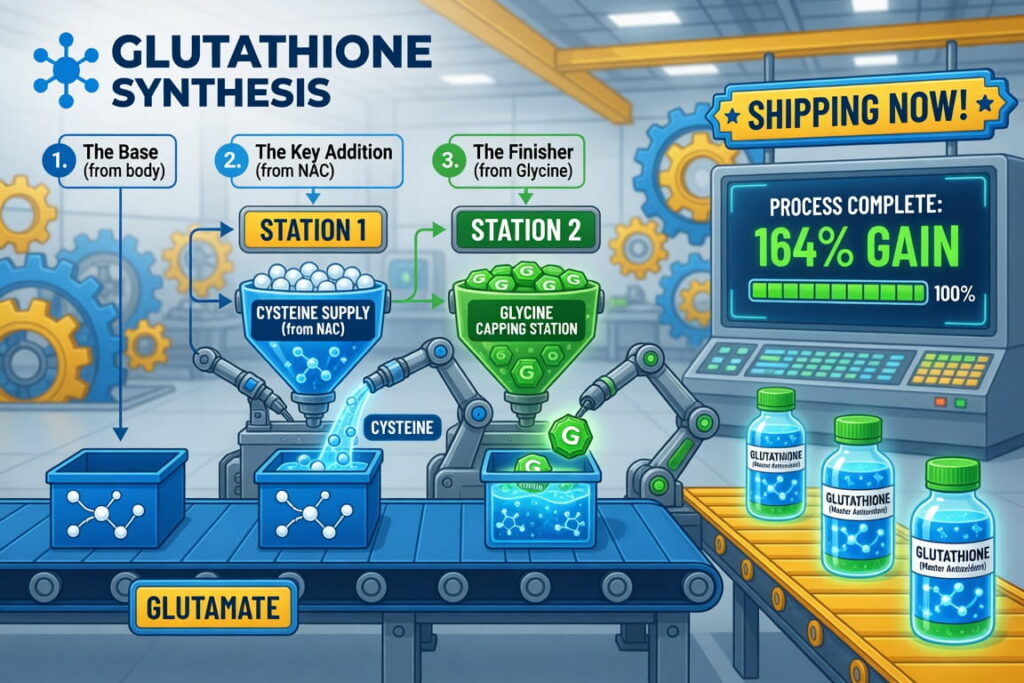
Picture a bottling line with two stations. The first station fills the bottle, the second one screws on the cap, and nothing ships until both stations have parts.
Glutathione, your cells’ primary internal antioxidant, gets assembled on exactly that kind of line from three amino acids:
- Glutamate
- Cysteine
- Glycine
NAC (N-Acetyl Cysteine) delivers the cysteine, which is typically the piece your body runs shortest on. Glycine attaches at the final step and releases the finished molecule.
So why does taking one alone fall short? It supplies only cysteine, and while cysteine is the most limiting factor in glutathione production, the line can jam up at the second station without glycine. Feeding both precursors together keeps the whole line moving, which is why the clinical research on this pairing used the combined approach (1).
What to Expect: Safety and Side Effects
Both are amino acids, not drugs, and both have long, well-documented records of safe use at supplemental doses. A few practical things still deserve a heads-up:
- Digestive Comfort: The most common complaint with either one is gastrointestinal, usually loose stools or mild stomach discomfort. It shows up almost exclusively at higher doses. Lower the amount or split it across the day, and it typically resolves.
- The Sensory Experience: NAC has a distinctly sulfurous smell that catches some people off guard; it is completely normal and comes from the sulfur in cysteine itself. Glycine tastes faintly sweet and dissolves almost instantly in water.
Start low and work your way up, then hold at whatever dose your gut tolerates comfortably before climbing higher.
Finding that sweet spot is well worth it, especially given the latest research on longevity.
When to Check With Your Prescriber First
There are a few situations where I want someone to check with their prescriber before starting either one:
- If you take nitroglycerin or other nitrates. NAC can amplify the blood-pressure-lowering and headache effects (2)
- If you take clozapine. Supplemental glycine has been reported to reduce its effectiveness (3)
- If you are in active cancer treatment. Antioxidants and certain chemotherapies are a genuine open question, and that conversation belongs with your oncologist rather than a supplement label.
- If you are pregnant or nursing. There is not enough data on either at supplemental doses to make a confident recommendation.
Do You Need Both, or Is NAC Enough?
NAC on its own will raise glutathione in most people, so glycine is not strictly required. Whether adding it helps depends on whether glycine is a limiting factor for you, and for a meaningful number of adults it is.
The reason comes down to arithmetic. Your body makes glycine, but the amount it synthesizes appears to fall well short of what it needs for all the jobs glycine does, from collagen to bile salts to glutathione. The biochemistry literature has described that shortfall for years, and it’s the strongest argument for supplementing it rather than assuming production meets demand.
Three things make added glycine more likely to matter:
- Age. Both cysteine and glycine availability tend to decline, which is why the research on this combination focused on older adults (1).
- A diet low in connective tissue. Glycine is concentrated in skin, bone, and cartilage. If you eat mostly muscle meat and no bone broth, gelatin, or skin-on cuts, your intake is likely modest.
- High demand. Recovery from injury, heavy training loads, and chronic inflammatory conditions all increase glycine demand.
Someone regularly eating collagen-rich foods may already be covered, and NAC alone is a reasonable place to start.
One honest limitation: the trials tested the combination against a placebo, not against NAC by itself. That means we can say the pair produced the results reported, but we cannot say how much of the effect glycine contributed. Anyone who gives you a precise split is going beyond the evidence.
It is also worth knowing that results have varied between studies, and the clearest pattern is that people who begin with low glutathione respond
How to Take Glycine and NAC
When to Take NAC and Glycine
Take them together, at the same time of day. They build different parts of the same molecule, so spacing them out offers no benefit. If better sleep is one of your goals, take them in the evening, since the glycine sleep research dosed it shortly before bed. If your stomach is sensitive, take them with a meal.
Form. Both come as powder or capsules. Powder is easier if you are adjusting the amount, and glycine dissolves readily with a faintly sweet taste. NAC has a noticeable sulfurous smell that some people would rather keep inside a capsule. Capsules are more convenient, though you will be taking several.
With or without food. Either works. If your stomach is sensitive, take them with a meal.
Timing. Glycine is the one where timing is worth thinking about. The sleep research used it shortly before bed, so if better sleep is part of what you are after, that is the slot to use (2; 4). NAC is flexible and can go whenever it is easiest to remember.
Start at the low end and hold there. Digestive comfort is the practical limit on both. Begin at the bottom of whatever range your product recommends, stay there a week or two, then adjust if you are comfortable. Loose stools or stomach discomfort almost always mean you climbed too quickly, not that the supplement is wrong for you.
How much is a conversation rather than a formula. Product labels give a sensible starting range, and that is where I would begin. Anything beyond the label belongs in a conversation with a clinician who can look at your labs and your medication list, because the useful amount depends on where your glutathione status actually sits.
Give it time. The older adults in the trial supplemented for 16 weeks, and the changes accumulated across that period rather than showing up in the first fortnight. A two-week trial tells you about tolerance, not about effect.
One caveat on the evidence. A later and larger trial in 114 older adults did not reproduce the glutathione increase seen in the earlier work (https://pmc.ncbi.nlm.nih.gov/articles/PMC9261343/).
This isn’t a direct contradiction, because the two studies differed in several ways: how long people supplemented, how much they took, which glutathione measure they used, and, most importantly, how depleted participants were at baseline. The earlier trial enrolled older adults with documented glutathione deficiency. The larger trial enrolled healthy older adults, and only a subset who began with high oxidative stress and low glutathione showed gains.
Glycine and NAC Benefits
Glycine: Not Just a Regular Amino Acid
People often think of Glycine as a common amino acid, but it does many things for our health:
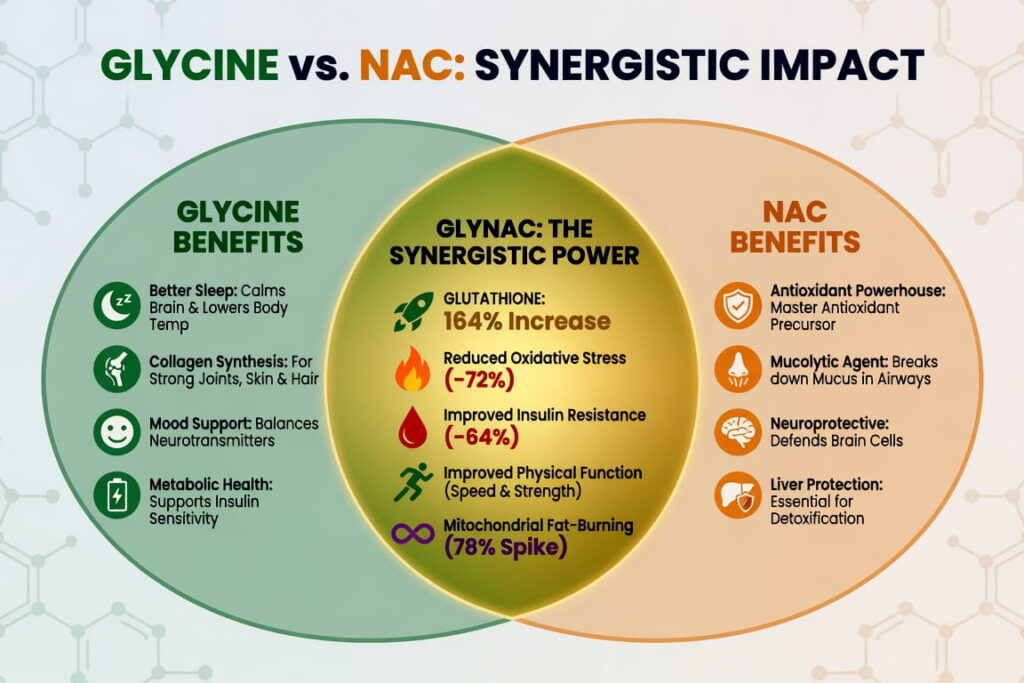
- Better Sleep: Glycine promotes deeper, more restful sleep by helping lower your core body temperature. It also acts as a calming neurotransmitter and supports GABA production to help your brain and body wind down(4; 5; 6; 7).
- Collagen Synthesis: As a primary building block of collagen, glycine is essential for maintaining healthy skin, supporting tissue repair, and keeping joints and muscles strong (8).
- Mood Support: By balancing excitatory signals in the brain (like glutamate), glycine’s naturally calming effects help maintain mood and support feelings of anxiety (9).
- Metabolic Health: Glycine is not only deficient in those who are obese or insulin resistant, but it can also help regulate blood sugar levels already in the normal range (10; 11). Because of its role in collagen formation, a glycine deficiency can make it more difficult for tissues to heal from damage caused by high blood sugar.
- Digestion: Glycine is a relaxing neurotransmitter and can help aid in “rest and digest” body functions. Glycine aids in the production of bile salts, which help us digest food better and play roles in detoxification (12).
- Anti-Inflammatory Properties: Emerging research hints at glycine’s potential anti-inflammatory properties, which could have broad implications, from managing “hallmarks” of aging, as well as chronic inflammation and autoimmune disorders (13). This may be related to its connection with glutathione synthesis, in which NAC is a precursor as well.
N-Acetylcysteine (NAC): A Broad Spectrum of Benefits
N-Acetylcysteine, commonly referred to as NAC, has a storied history in the scientific community, not only for its role when combined with glycine but also for its individual merits.
- Antioxidant Powerhouse: NAC is good at fighting against damage in our cells (14; 15). It helps make an important “master antioxidant” called glutathione, which fights harmful substances in our body (16).
- Mucolytic Agent: Traditionally, NAC has been used as a mucolytic agent, helping break down mucus in the airways (15). This may make it a valuable tool in managing conditions like chronic bronchitis, cystic fibrosis, or a stuffy nose (18; 19).
- Neuroprotective Qualities: Like Glycine, NAC might help protect the brain. Studies suggest that NAC may have neuroprotective effects. It has been explored in the context of neurodegenerative diseases, such as Alzheimer’s and Parkinson’s, with some research suggesting its potential to slow down cognitive decline (20).
- Mental Health: An exciting avenue of research has been the use of NAC in managing certain psychiatric conditions and substance use disorders. Preliminary results indicate potential benefits for mood disorders, obsessive-compulsive disorders, schizophrenia, and even helping with addiction (21). The potential combined effects of glycine and NAC might be even more interesting in this regard.
- Liver Protection: NAC is occasionally used in the medical setting for acetaminophen (example: Tylenol) overdose due to its liver-protective properties. It can help replenish glutathione, which is essential for neutralizing the harmful byproducts of acetaminophen metabolism (22). It’s found in many liver support formulas. Milk thistle is a common pairing question too, and the two work on different parts of liver support rather than overlapping. I covered the oxalate question that usually comes up with it here)
New Study on Glycine and NAC Benefits
The study looked at how Glycine and NAC (together called GlyNAC) affected signs of aging. 36 people took part. They looked at various health measures like oxidative stress and insulin resistance to blood pressure and body composition.
The research design was a randomized controlled study, where participants were administered either GlyNAC at a dose of 100 mg/kg/day or a placebo (alanine) at 200 mg/kg/day. The older adults underwent the regimen for 16 weeks, whereas the younger group underwent it for 2 weeks.
Assessments ranged from physical function tests, such as walking speed and grip strength, to markers indicating inflammation and oxidative stress. Additionally, they looked at body composition.
Key Outcomes of the Glycine and NAC Study
After 16 weeks of GlyNAC supplementation, older adults had:
- A significant rise in glutathione levels, soaring up by 164%
- A remarkable reduction in oxidative stress indicators, with a main marker improved by 72%.
- Improved physical function was evident from improved gait speed, grip strength, and sitting-to-standing test results.
- A 78% spike in mitochondrial fat-burning activity.
- A considerable improvement in insulin resistance by 64%
- Beneficial changes in inflammation markers (drops in IL-6, TNF-alpha, sICAM1, sVCAM1, and CRP) and a rise in the anti-inflammatory IL-10.
- Decreased waist size and blood pressure
Interestingly, many of the older adults in the study reached levels seen in the younger adults.
Improvements spanned a broad spectrum, from cardiometabolic health to physical function, making the combined supplementation an exciting area of clinical nutrition.
Best NAC and Glycine Supplements:
When I supplement with NAC individually, I use my N-Acetylcysteine (NAC) 500mg, and for glycine, I like Glycine Capsules and Glycine Powder.
Pure Encapsulations combines both ingredients in their NAC + Glycine Powder supplement. This is my go-to source for someone wanting the combination.
Related Articles:
- Can you take Milk Thistle and NAC Together? – Yes, here’s what I use, and some new details about milk thistle you might not know.
- New Discoveries on the Benefits of N-Acetylcysteine – Glutathione, Antioxidant, Respiratory health, biofilm disruption and more.
- Nitrate Supplements for Sex, Cardiovascular Health, Immunity, and the Gut – Discover the nitric oxide pathway that doesn’t drop 50-80% with age like the arginine pathway.
- Berberine Blood Sugar Benefits – The strategy to maintain normal blood sugar that, according to preliminary research, may be as effective as metformin without the side effects.
- Benefits of Nicotinamide Riboside – a New Form of Vitamin B3 – Supports NAD+ levels, the only molecule your body cannot live without besides ATP. If stressed, NAD+ levels drop. They also drop naturally with age. Support it naturally with Nicotinamide Riboside (NR), commercially known as TruNiagen.
- The Anti-Aging Benefits of Vitamin K2 – Many know about the benefits and importance of Vitamin D3, the problem is, you need K2 to maximize that benefit.
- Creatine Monohydrate Benefits – Creatine has been “stuck” in people’s minds as a gym supplement; it’s much more than that – the brain needs it arguably more than your muscles.